EU Cohesion Barometer - October 2026
Published on October 1, 2026

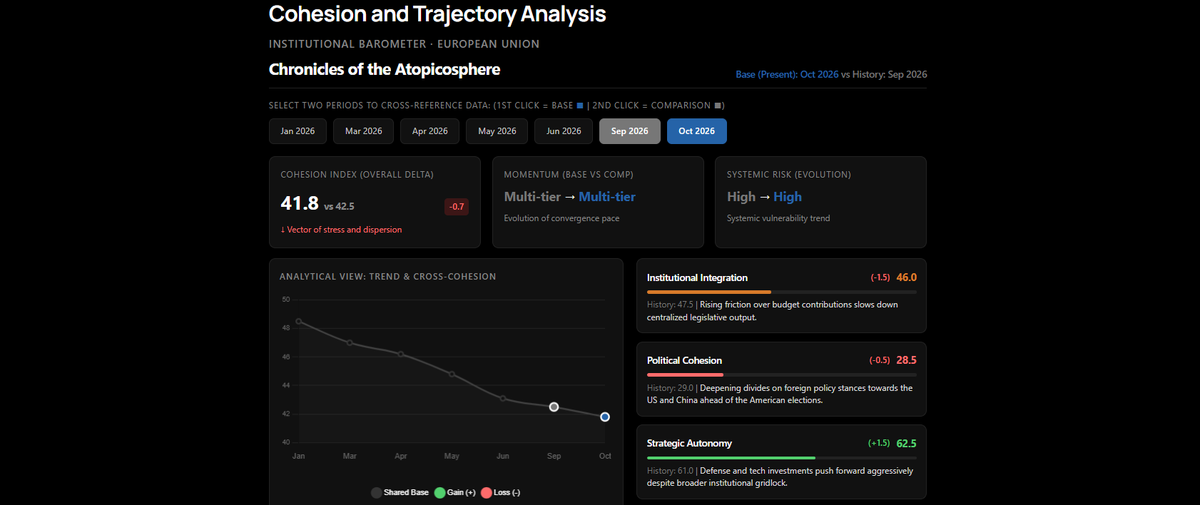
The European Union Cohesion Index records a continuous decline throughout 2026, falling from a baseline of 48.5 in January to 41.8 in October. This retreat reflects a persistent structural stress factor within the bloc, accompanied by Systemic Risk that escalated from "Low" at the start of the year to "High" from June onwards, stabilizing at a critical level amidst investment paralysis and global trade tensions.
The Six-Dimension Radar: Diverging Vectors
- Strategic Autonomy (The Sole Growth Driver): This is the only dimension with a clearly upward trajectory, rising from 54.0 (Jan) to 62.5 (Oct). The surge is driven by aggressive investment in energy resilience (joint procurement) and the development of defense and semiconductor infrastructure, compelled by external pressure from the United States and China.
- Political Cohesion (The Deepest Fracture): This dimension suffers the sharpest decline, dropping ten points (from 38.0 to 28.5). It reflects polarization over external tariffs, chronic foreign policy deadlocks, and the emergence of debates regarding sub-regional alliances in the face of the Franco-German axis protecting its own interests.
- Fiscal and Institutional Integration (The Impasse): Fiscal integration retreats from 43.5 to 36.0, highlighting resistance from conservative states to new joint borrowing initiatives and debt mutualization. Institutional integration follows this downward trend (from 52.0 to 46.0), underscoring the inability to create a single capital market capable of preventing the flight of European talent and startups to jurisdictions like Delaware.
- Enlargement and Governance Dynamics: Both are experiencing a gradual decline. The enlargement process has stalled at 45.0, blocked by debates over the bureaucratic model and the inability to reform cohesion funds, while democratic governance has fallen to 41.5 due to fragmentation regarding European data sovereignty and persistent inter-institutional friction.
Trajectory Shift and Momentum
The barometer records a distinct operational transition. In January, the system was in a state of "Stagnation" (positioned at 42.0). Between March and June, negotiation friction pushed the bloc toward "Selective Mutualization," finally stabilizing in September and October in the "Multi-tier" quadrant (governance at varying speeds, at 56.5). A reactive core's obstructionism is forcing the most dynamic Member States to move forward with fragmented solutions, bypassing the overarching architecture of the 27.
The Central Strategic Narrative: The barometer quantifies the limits of an institutional model designed to function like a guild. Current rules tie the capacity to compete in the global market to each country's demographic and budgetary weight, allowing for the protection of 20th-century industrial and technological positions at the expense of creative destruction and innovation on the Union's periphery. The isolated acceleration of "Strategic Autonomy" reveals that the European response to external shocks—such as blocked critical mineral supplies or the rising cost of technological CapEx imposed by Washington—is being executed as a survival and de-risking reflex, rather than as the product of deep federalization. The system consumes increasing amounts of political energy just to remain functional, pushing real solutions outside the framework of the common treaty.