
AI BUBBLE
SPECIAL EDITION
 amorsantos

In the essay "The Loop and the Black Hole," the author deconstructs the financial exuberance fueling the current artificial intelligence and semiconductor boom. The text employs the metaphor of a "black hole" to describe the closed loop linking giants like Nvidia and Big Tech: a spiral that absorbs massive amounts of capital, talent, and energy resources based on the promise of exponential profits, yet whose created value rarely radiates transformatively into the broader real economy. The analysis exposes the profound unsustainability of this model on multiple fronts. The author maps everything from uncompensated mineral extraction in the global periphery and the voracious electricity consumption of new data centers to the extreme geopolitical fragility of highly concentrated physical supply chains. It further demonstrates that current stratospheric stock valuations function as a self-reinforcing scheme, where share value itself serves as currency to acquire talent and mask the lack of commensurate real value added. Central to the geopolitical and economic reflections of this special report, the text warns that this technological "loop" is a fragile house of cards. When the inevitable contraction arrives—driven by physical or climatic limits or monetary bottlenecks—the resulting global systemic shock will highlight the urgent need for genuine strategic autonomy and international regulation.
 amorsantos
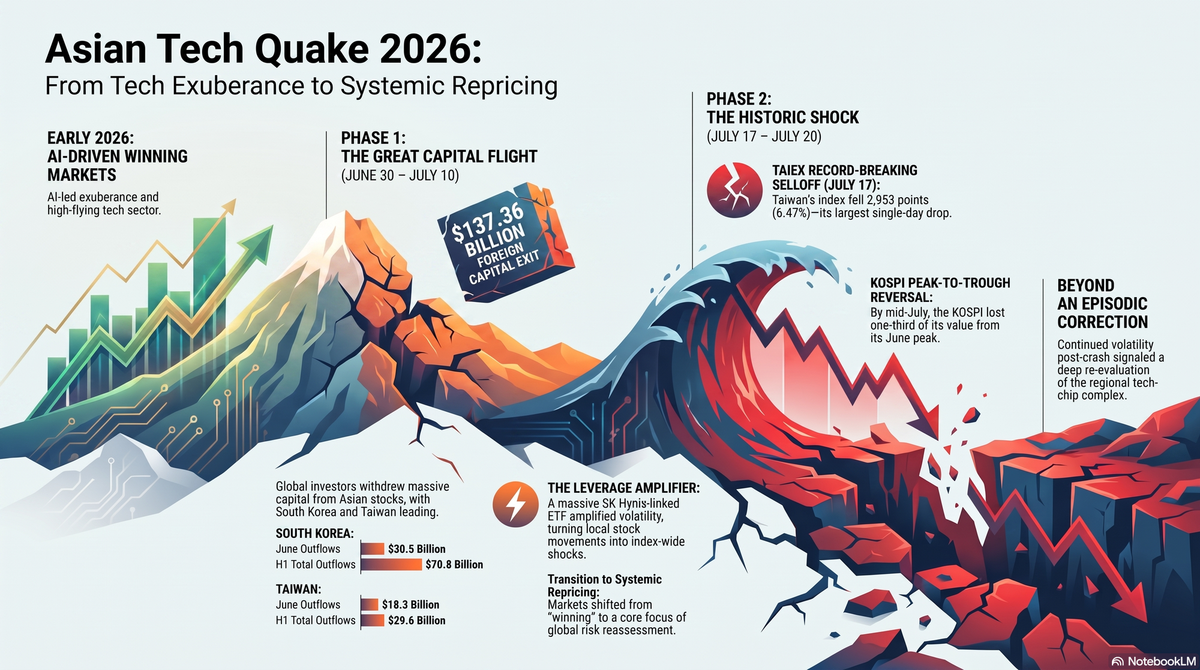
In this essay, "The Loop, the Abyss, and the Reflection of Denial," the author dissects the profound irrationality underpinning the current Artificial Intelligence and semiconductor bubble. By analyzing the astronomical swings in the market value of giants like Apple and Nvidia, the text reveals a financial ecosystem intoxicated by promises of exponential profits—one that prices in a utopian future while deliberately ignoring the real world's physical, energetic, and geopolitical limits. The author demonstrates how these unrealistic valuations have morphed into a veritable "stock-as-currency" used to pay salaries, turning stock market volatility into a direct human threat and a critical risk of talent flight should valuation multiples collapse. More than a mere market anomaly, we are witnessing a structured denial: a refusal to accept that Big Tech’s capital "black hole" relies viscerally on tangible, fragile realities—ranging from mineral extraction in Kolwezi to the voracious electricity consumption of new data centers. This is an essential read for this special feature, compelling us to look beyond Wall Street and confront the glaring inconsistency between today’s speculative exuberance and the economy we are plausibly capable of building tomorrow.
 amorsantos
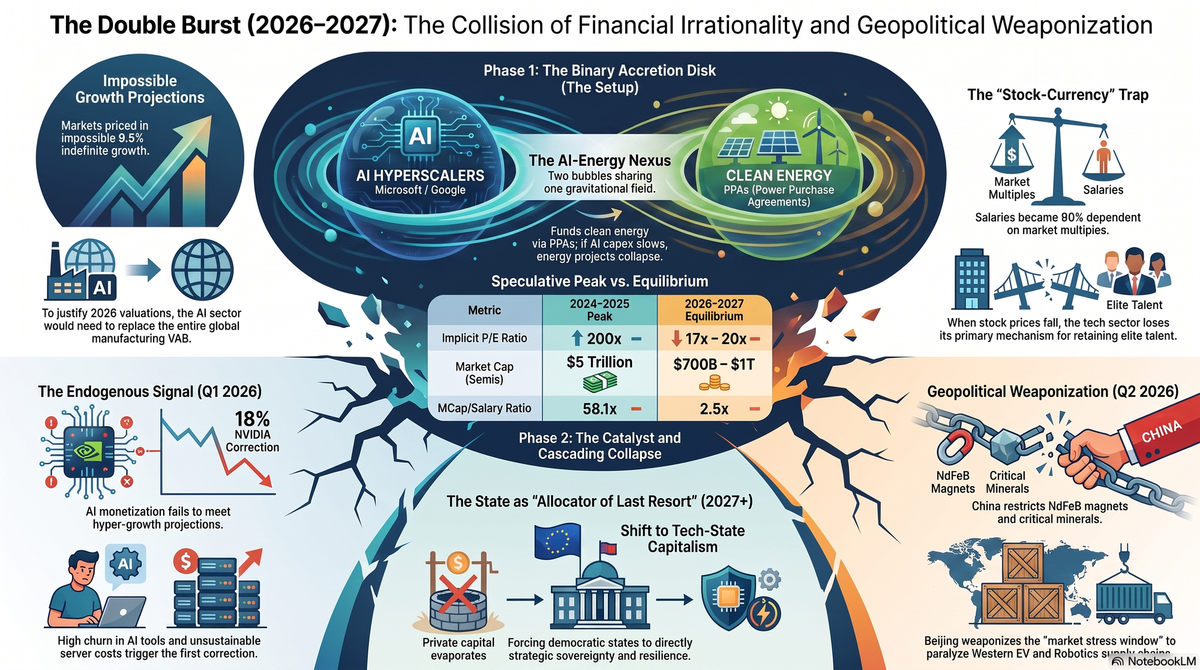
In the essay "The Double Burst," the author constructs a prospective scenario (2026–2029) in which the financial irrationality of the current Artificial Intelligence bubble collides head-on with global geopolitical weaponization. The text identifies a "binary accretion disk," demonstrating how the hyper-valuation of AI and the clean energy bubble share a gravitational pull and a fatal interdependence. The envisioned collapse begins endogenously: the monetization of AI tools falls short of impossible growth projections, triggering a violent market correction and the implosion of the stock-based compensation system that sustains tech talent. It is within this precise window of vulnerability that geopolitics comes into play. The scenario projects that China will exploit this moment of stress to restrict the export of critical minerals (such as NdFeB magnets), transforming a mere financial adjustment into a cascading systemic collapse that paralyzes Western value chains. Essential for framing the debates in this special report, the text demonstrates that technological exuberance constitutes a profound strategic vulnerability, speculating—in an extreme scenario—on the end of the free-market illusion and a forced transition to "Technological State Capitalism."
 amorsantos
The essay "Nvidia: The Loop Has Entered the Testing Phase" analyzes the apparent paradox of the tech giant's recent quarterly results: record revenues of $96.22 billion met with a drop in its stock price. This phenomenon signals that the market is no longer evaluating merely current execution, but rather the viability of the very circular validation mechanism underpinning the Artificial Intelligence ecosystem. The text outlines how Nvidia has evolved from a mere supplier into a financier of infrastructure, leveraging a "loop" in which massive investment from platforms fuels its margins, thereby validating a narrative that attracts even more capital. Using the evocative metaphor of a "black hole," the author warns that this system voraciously consumes financial resources, talent, and electricity. However, its sustainability requires that this intense financial radiance project real economic value and widespread productivity into the rest of the economy. Essential for understanding the dynamics explored in this special report on the "AI Bubble," the essay demonstrates that quarterly exuberance is no longer enough: the market now demands concrete proof that hardware investment will generate tangible returns beyond the closed technological loop itself.
 amorsantos

In the essay "Nvidia: Multiple Compression Won´t Entice Markets," the author dissects the semiconductor giant's recent re-rating, arguing that the company is not being penalized for a lack of growth, but rather because the market questions the sustainability of that growth. Despite consistently beating quarterly estimates and maintaining profit margins around 75%, the drop in its forward earnings multiple to below 17x reveals a profound paradigm shift. Investors accept today's extraordinary profits but refuse to pay upfront for another decade of limitless expansion. The text frames this dynamic as the inevitable transition from the "cycle of belief" to the "cycle of demonstration." For the current Artificial Intelligence loop to remain viable, empirical proof is now required to show that massive infrastructure investment by major platforms translates into real economic productivity—rather than merely a defensive race driven by the fear of being left behind. Central to this special report on the AI Bubble, the analysis demonstrates that the sector's true risk lies in the ecosystem's potential inability to justify—within the real economy—the multi-million-dollar infrastructure it is currently building.
 amorsantos

What if the greatest risk of artificial intelligence lay not in the machines, but in the way we pay for them? Five companies are on track to be worth the equivalent of one-fifth of global GDP, sustained by revenues that amount to less than 2% of it. Since 2022, Nvidia and the hyperscalers have added $14 trillion in market value; the leading energy groups, less than $0.6 trillion. Those who consume energy have added twenty times more value than those who produce it. Meanwhile, the bill lands on people who were never consulted. Electricity bills are rising in America's largest power market, coal plants are having their closures postponed, water is fought over in the middle of a drought, and phones are getting more expensive. European savings fund American infrastructure, pensions and insurers carry the risk of private credit, and states paying interest rates at multi-decade highs become the implicit guarantors of a bet they do not control. This article follows the money: from stock indices to power grids, from a yen defended with euros to Meta's and Amazon's bonds. And it arrives at the question that matters: what happens to the contract between citizens and the state when public decisions start to obey a share price? The rupture does not arrive with the collapse. It has already begun