Nvidia: multiple compression won't entice markets
Published on September 24, 2026


Nvidia is not being repriced because it has stopped growing. It is being repriced because the market has finally started asking how long it can continue growing like this.
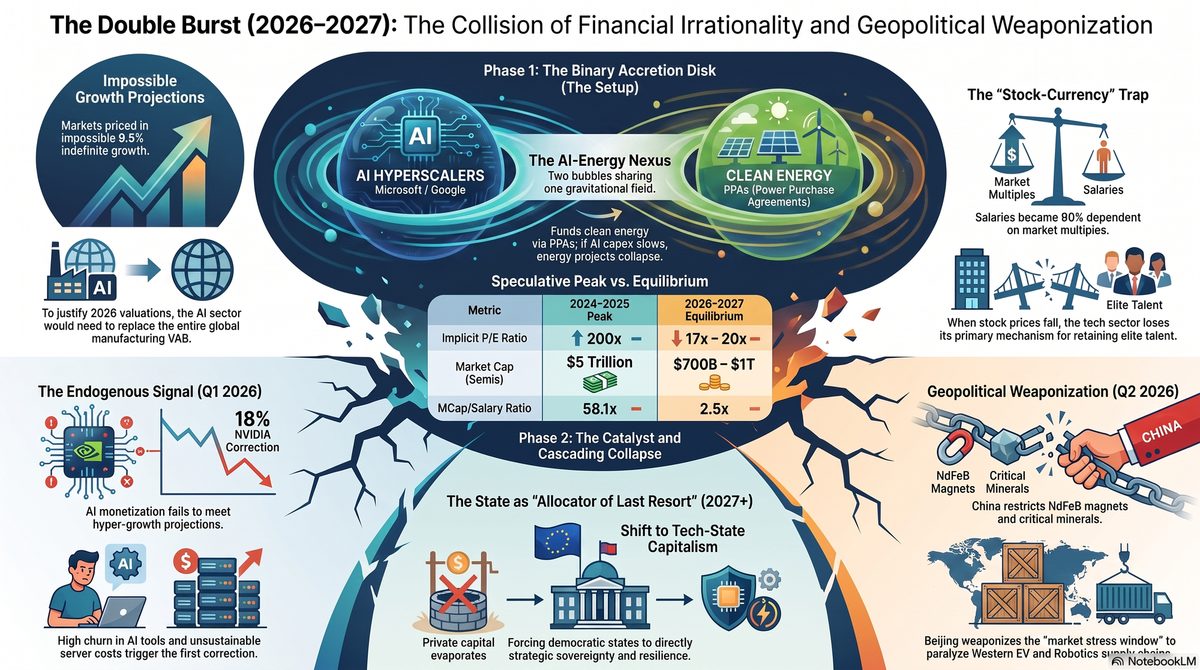
A recent article on ndtvprofit.com —"Nvidia’s Stock Is Flashing a Warning Sign as Valuation Drops"—might seem counterintuitive. The company maintains forecasts of exceptional growth: around 90% in revenue and 99% in net income for fiscal year 2027, followed by further strong growth the following year. Yet, its forward earnings multiple has fallen to less than 17 times—roughly half the level seen for 2025.
A superficial reading offers reassurance: after a speculative peak, Nvidia’s stock has undergone a correction. However, this conclusion conflates price with risk. A lower multiple does not automatically immunize the stock against valuation-related consequences; it may simply reveal that while the market accepts today’s extraordinary earnings, it is no longer willing to pay upfront for another decade of exceptional performance.
That is the decisive distinction.
Nvidia may continue to beat quarterly expectations, sell unprecedented volumes of accelerators, and generate margins envied by almost every industrial company. None of that answers the question that now matters: who will purchase the next wave of computing capacity, and on what economic return?
The cycle that must prove itself
The central mechanism of the AI expansion can be expressed as:
AI CAPEX→platform revenue/profit→renewed CAPEX→Nvidia revenue.
During the upswing, this mechanism appears self-validating. Microsoft, Meta, Alphabet, Amazon, and other major buyers invest in data centres and GPUs; Nvidia converts that investment into revenue, margins, and market capitalisation; Nvidia’s appreciation is interpreted as evidence that the AI race is economically rational; that validation enables further investment, credit, and capital expenditure. (The Loop and the Black Hole III)
The loop creates real revenue, real customers, and real physical infrastructure. The argument is not that demand is fictitious. The issue is its economic quality. Demand financed by end-user cash flows, measurable productivity gains, and recurring revenue is fundamentally different from demand driven mainly by competitive defence — each platform’s fear of falling behind if its rivals continue spending.
As long as the first link expands, Nvidia can report exceptional results. But its valuation depends on the third link — future CAPEX renewal — remaining elevated for many years. If platforms keep purchasing capacity to preserve strategic position but cannot turn that capacity into profitable AI services, demand will remain strong in the short term while becoming less financially sustainable.
This was the central argument in “Nvidia: The Loop Has Entered the Testing Phase”: beating consensus is no longer enough because quarterly results confirm the present, but do not demonstrate that computing demand can keep doubling for as long as valuations require.
The market accepts earnings, not duration
The decline in Nvidia’s forward multiple to below 17 times earnings should be read as something more subtle than a change in sentiment. The market appears to be separating three propositions that, during the euphoric phase, were treated as one:
- Nvidia has exceptionally strong current demand.
- That demand can sustain an exceptional growth trajectory for many years.
- AI is already creating sufficiently broad economic value to renew that investment indefinitely.
The first proposition remains supported by revenue. The second has become contestable. The third remains the least observable variable and the most consequential. (read “Nvidia: The Loop Has Entered the Testing Phase”)
According to the figures cited in the news report, Nvidia’s sales are expected to have risen from roughly $27 billion in the fiscal year ended January 2023 to about $410 billion in fiscal 2027. This is not merely rapid growth; it is one of the most extraordinary concentrations of corporate growth in recent economic history.
The question is therefore no longer whether Nvidia can sell more chips next quarter. It is whether the profits now projected constitute a durable economic base or the product of an unusually intense, highly concentrated, and temporally finite investment race.
In that context, a 17-times forward earnings multiple may mean something very different from “cheap.” It may mean: I accept the projected profits, but I refuse to pay today for another ten years of almost frictionless expansion.
The testing phase
Nvidia’s market reaction after earnings had already signalled a regime change. The company reported quarterly revenue of $96.22 billion, around 106% higher year on year, and beat published estimates; nevertheless, the stock initially fell after the release.
This apparent contradiction is actually the confirmation of the thesis. When a company beats expectations and the market marks down the shares, investors are not disputing the completed quarter. They are raising the hurdle for the future. Markets are saying that today's profits have already been factored into the narrative supporting the valuation, but the most important thing is missing: demonstrating their repeatability.
Nvidia is no longer valued simply as a semiconductor manufacturer. It has become the financial node of a much larger promise: that AI computing will reorganise productivity, services, industry, logistics, advertising, healthcare, and intellectual labour at a scale large enough to justify the infrastructure now being built.
The earlier essays framed that requirement in macroeconomic terms: market capitalisations vastly exceeding present value added embed a promise of future transformation, not merely current output. The relevant question is not “what is Nvidia worth today?” But what kind of economy must exist tomorrow for today’s price to make sense?
The Loop and the Black Hole II
The Loop and the Black Hole III
The cut in gross margin
The report contains a second important signal. Nvidia’s gross margin was 75% in the second quarter, while consensus pointed to less than 72% in the fourth quarter amid rising component costs, including memory.
A three-percentage-point movement in margin is not significant. But for a company whose exceptional status rests on the conjunction of explosive growth, technological dominance, and extraordinary profitability, even modest margin compression carries strategic meaning. It reminds investors that monopoly rents do not float in a vacuum: they depend on memory, advanced packaging, electricity, water, networks, industrial capacity, and bargaining power against enormous customers.
The issue is not whether Nvidia will suddenly cease to be highly profitable. It is whether a 75% gross margin should be understood as structural or as a temporary rent from a particular phase of technological scarcity. If customers develop proprietary chips, specialised alternatives gain share, and component costs rise, Nvidia can retain colossal revenue while losing some of the pricing power that justified its exceptional premium.
Nvidia’s scale itself creates the incentive to challenge it. Its largest customers are not dispersed consumers without strategic options. They are Meta, Alphabet, Microsoft, and Amazon: firms rich enough, technically capable enough, and strategically motivated enough to internalise parts of their computing stack through ASICs, inference accelerators, and proprietary architectures.
Not the end of the loop
None of this proves that the AI cycle has ended. Nvidia continues to benefit from extremely strong demand, major cloud operators continue to invest, and improvements in model capability may still generate applications with significant economic returns.
But serious analysis must separate operational continuation from economic validation. GPU demand can keep rising even as the marginal return on that demand falls. Data centres can continue to be built even while customer monetisation underperforms expectations. Infrastructure can be financed even as risk shifts from the highly liquid balance sheets of major technology firms toward private credit, institutional funds, and long-term capital.
This is where the black-hole metaphor retains its explanatory power. The system continues to absorb capital, electricity, water, talent, network equipment, memory, and manufacturing capacity. Financial brightness can intensify before it is demonstrated that the absorbed energy becomes productivity diffused through the wider economy. (read The Loop and the Black Hole III)
The decisive question remains external to the Nvidia–cloud–model circuit: is AI producing revenue, productivity, and value added across sectors broadly enough to renew the investment and justify the creative destruction on which it depends?
Until that question has a convincing empirical answer, Nvidia’s earnings validate the strength of the loop, but not its sustainability.
The thesis confirmed
The news does not announce an implosion. It reveals something more important: a transition from a cycle of belief to a cycle of demonstration.
Nvidia does not need to fail in order to be repriced. It is enough for the market to conclude that the extraordinary profits of the next few years are real but not indefinitely expandable; that current demand is partly defensive competition; and that final AI monetisation has not yet caught up with the scale of the infrastructure built to enable it.
A lower multiple is not merely a market price correction. It is the first financial language of a deeper doubt: not about Nvidia’s present execution, but about the duration of the exception that its price, margins, and centrality have come to require.
Nvidia is not being repriced because it has stopped growing. It is being repriced because the market has started asking how long it can continue growing like this.
 amorsantos