
Special Edition - EU, What future?
 amorsantos

This pivotal essay in our special series offers a counterpoint to the previous piece, "Why Should the Peripheries Leave the EU?" The author argues that the answer to the European impasse is not abandonment, but rather profound, federalist reform. The text diagnoses that the current European Union is worth far less than the sum of its parts, heavily hamstrung by guild-like policies that fragment the market and stifle the potential of vital sectors—ranging from energy and defense to technological innovation. The author demonstrates that this fragmentation and the lack of a genuine single capital market harm both the most dynamic European peripheries and the Franco-German industrial core itself, which is increasingly losing strategic ground to powers like the United States and China. The proposed solution entails creating a Single Capital Market; the author puts forward a concrete proposal aimed at mobilizing the €10 trillion in European savings currently sitting idle in banks through the creation of federal investment mechanisms based on merit rather than geography. While regarding the EU as the world's freest and most socially cohesive model of society, the essay issues a crucial warning: to survive and compete, Europe must transcend its patchwork of national interests and embrace its identity as a true federation.
 amorsantos
In this essay, the author explores the European Union's power dynamics through the theoretical lens of "extractive institutions," a concept developed by economists Acemoglu and Robinson. The central thesis argues that the European decision-making architecture functions like an old-fashioned guild, wherein the Franco-German axis actively protects its oligopolies and obsolete economic models rather than embracing innovation. This chronic fear of "creative destruction" manifests as regulatory barriers and a structural bias—evident, among other things, in vast disparities regarding state aid. Consequently, Europe’s peripheral regions—despite possessing talent and promising ecosystems (spanning from the Iberian Peninsula to Eastern Europe)—face a shortage of venture capital. Lacking market scale, the most promising innovative companies are ultimately forced to relocate to the United States. Serving as an ideal framework for the debates in this special report, the text poses an inescapable challenge: faced with a Union that threatens to become a 20th-century economic museum, should the peripheries accept stagnation, or should they actively seek new global partners and force a break with the status quo?
 amorsantos
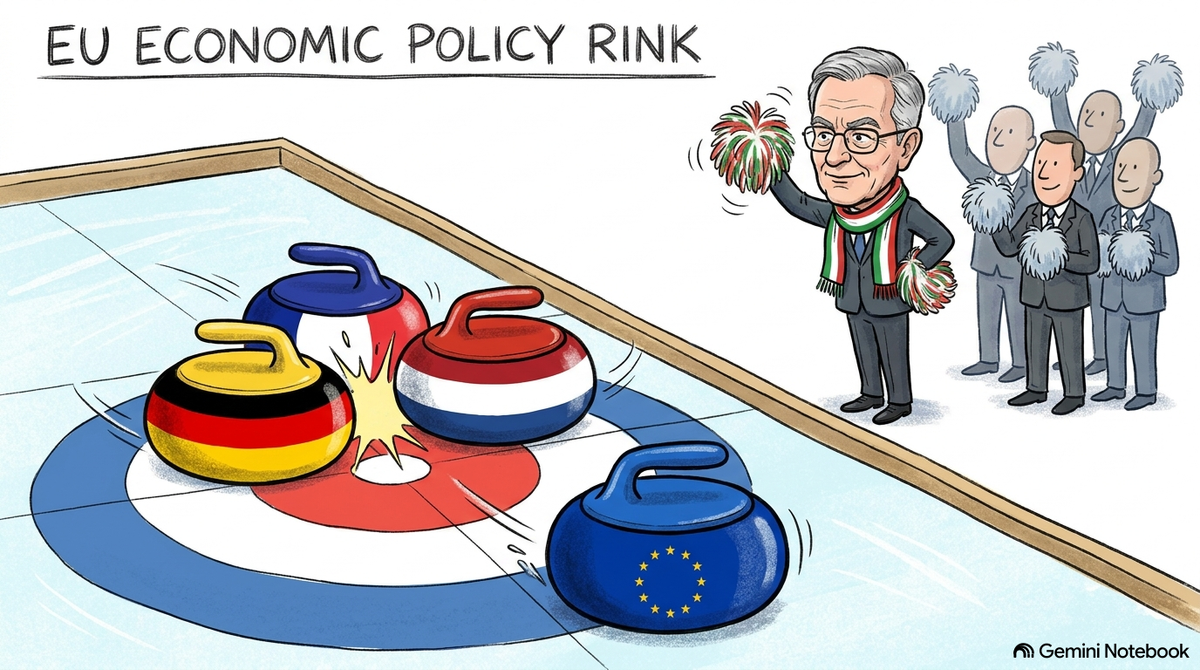
The essay "MARIO DRAGHI, IL MAGO DELLA BUROCRAZIA" offers a ruthless dissection of the much-debated report on European competitiveness. The author acknowledges Draghi’s historic merit in admitting—with statistical detachment—the collapse of the EU’s growth model and the structural productivity gap vis-à-vis the United States. The text highlights the blunt indictment of the European "regulatory trap," where the unchecked proliferation of directives stifles startups in their infancy, acting as both a bureaucratic quagmire and a protective shield for entrenched, obsolete industries. However, the analysis exposes a profound contradiction in the prescribed solutions: diagnosing the strangulation caused by excessive intervention, only to propose an annual injection of €800 billion in a massive exercise of centralized planning. To the author, the report commits an error of institutional complicity, amounting to a final attempt to use public funding to salvage the rent-seeking model of a guild-like political order—German industry, French agriculture, and Dutch logistics—under the guise of "strategic autonomy." It is an essential read for this special feature, demonstrating why saving the European project will require real shocks and an end to quota-based parochialism, rather than more centralized financial packages.
 amorsantos

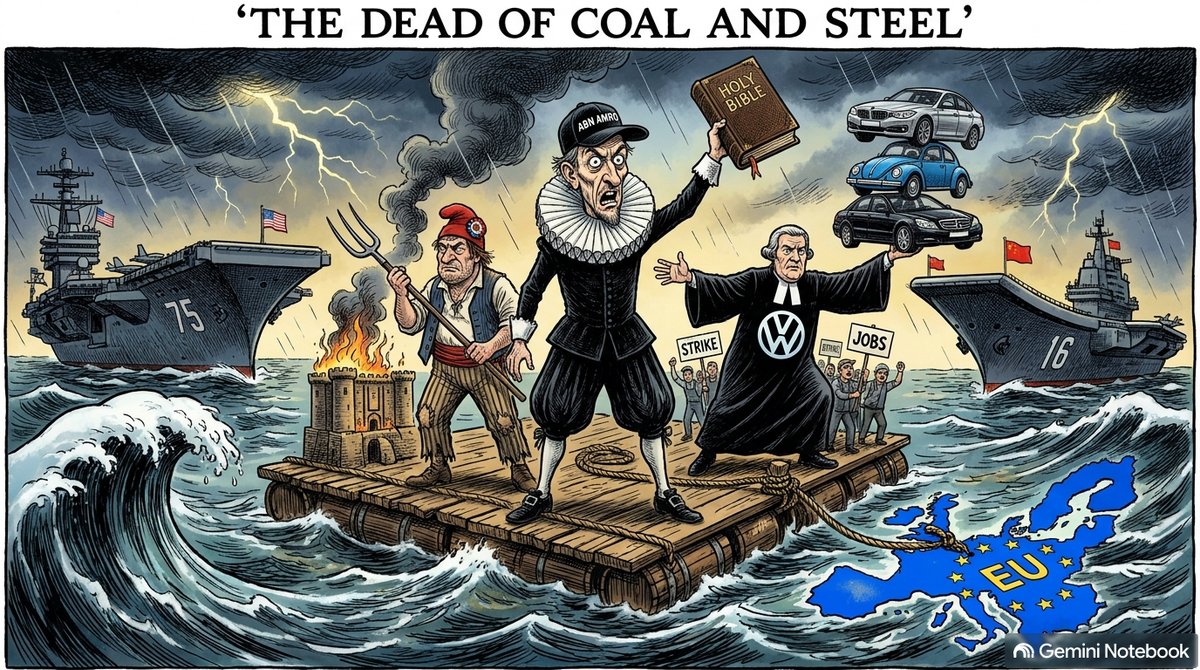
In the essay "Calvin and Kafka Get Married in The Hague," the author ironically explores the so-called "Dutch Paradox," regarding it as one of the major macroeconomic contradictions of European integration. The text dismantles The Hague's political narrative—centered on "frugality" and fiscal rigor—by revealing that the Netherlands is, in fact, the largest proportional beneficiary of the Single Market and the effects of Cohesion Policies. The data presented is overwhelming: for every euro of net contribution to Brussels, the Dutch economy recoups between 12 and 15 euros, expanding its GDP by 8% to 10% annually. Thus, the "frugals'" obsession with cutting the EU budget amounts to genuine economic suicide; it is estimated that every euro "saved" results in a contraction of 1.35 to 1.60 euros in the Dutch GDP itself. Beyond the economic aspect, the essay draws a fascinating cultural parallel. While the Southern and Eastern peripheries have become secularized and embraced pragmatic rationality, the Dutch elite has plunged into a form of "bureaucratic Calvinism," treating deficits as sin and surpluses as divine predestination. This is a provocative and essential reflection—featured in our special report—for understanding the hypocrisies that threaten the EU today.