EU Barometer
Published on July 9, 2026


 amorsantos
Welcome to the presentation of the key results from the June 2026 EU Institutional Cohesion Barometer.
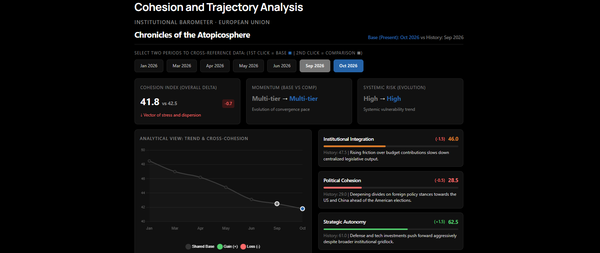
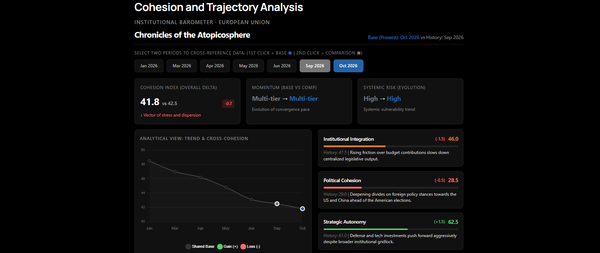
June saw a slight easing of the overall EU Cohesion Index. However, Systemic Risk—which measures the pressure of exogenous factors on cohesion resulting from an inefficient and erratic CFSP, combined with political and economic pressure from the two major geopolitical blocs—remains high.
The Bureaucratic Exception
Focusing on the key indicators of the EU Barometer’s Cohesion Index, the only clearly positive indicator is the Strategic Autonomy Index. This is heavily influenced by relatively consistent, long-lasting policies focused on electrification, the reduction of energy dependency, and trade agreements with Mercosur and India. We also note a return to positive territory for the Institutional Integration Index, driven primarily by the approval of the "One Europe, One Market" roadmap for 2027.
The Shortsighted Calvinist
The Political Cohesion and Fiscal Integration indices show the worst results in our barometer. The absurdity is twofold: the "Frugals"—who pride themselves on fiscal prudence—are the ones who benefit most from integration (€1.50 return for every €1 contributed). Yet, they are the very ones stalling the 2028–2034 MFF, as if Europe could compete with China or the USA on "minimal state" budgets. This is the context in which we are witnessing deepening divergences regarding the 2028–2034 MFF, explaining why these indices show the poorest results in our barometer. Two other indicators are tending to remain in negative territory: Enlargement Dynamics—which lacks a clear strategy and at times appears overly reactive to the unfolding events of the invasion of Ukraine and neighboring territories—and... Regarding the second indicator—Democratic Governance—a lack of vision and political leadership leaves the Union held hostage by its own complexes concerning legitimacy and representation; this creates the ideal environment for legislative and executive inefficiency—manifested, for instance, in the delay or even indefinite postponement of the transposition of European directives—thereby underscoring the European Union's geopolitical fragility vis-à-vis the North American and Chinese systems of governance.
This perception of a continent under strain is corroborated by the Spring 2026 Eurobarometer, which reveals that 44% of European citizens feel uncertain about the future, even though 75% view the EU as a zone of stability in a turbulent world. Despite confidence in institutions, inflation and the cost of living remain the primary concern for 47% of respondents, emerging as the major political challenge for the coming years.
In short, the analysis from the EU Institutional Cohesion Barometer (May–June 2026) depicts a European Union grappling with conflicting forces: growing geopolitical assertiveness and internal oversight contrasting with fragmented political and fiscal cohesion, reflecting the tension between Brussels' strategic vision and national realities.