G7 and BRICS in the New Global Reordering: Europe as a Supporting Player and the "Route of Resentment" of the Global South
Published on March 23, 2026


There is a structural irony in the architecture of contemporary power: the two blocs that present themselves as protagonists of the new global reordering — the G7 and the enlarged BRICS — are both constructions of convenience. One has lost the capacity to dictate universal rules; the other never truly intended to replace them with a common project. Between the two, the international system ceases to resemble a chessboard and starts to look like a marketplace where loyalty is negotiated — and the currency of exchange is resentment.
Europe in the supporting role
Let us begin with the apparently stronger side. For three decades, the G7 was the executive directory of the world economy. Today it increasingly consolidates itself as a bloc of political concertation under the hegemonic leadership of the United States — and the European Union, despite the size of its economy and the ambition of its rhetoric, occupies within it an essentially functional position.
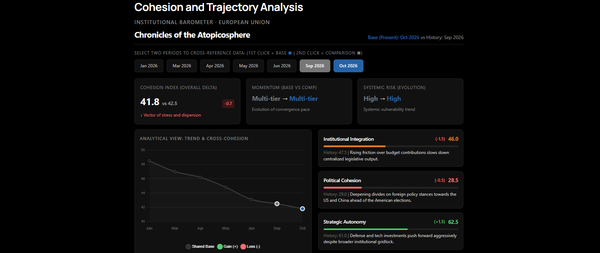
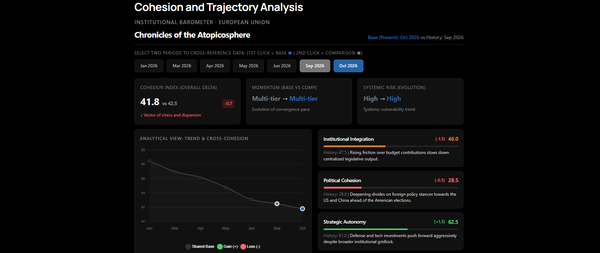
The promise of "European strategic autonomy", so emphasised over the past decade, has collided with hard realities. The continent's security architecture proved deeply dependent on the American military umbrella, via NATO, and that dependency has redrawn the internal hierarchy of the Western bloc. Europe today performs a triple function:
First, it is a market extension. The EU has become the great absorber of American capital, technology and energy exports — the accelerated transition from dependence on Russian gas to American LNG is the most perfect example of this substitution of landlords. And at the same time, its regulatory power, the famous Brussels Effect, is frequently mobilised not to project autonomy, but to harmonise and operationalise sanctions and trade restriction regimes decided in Washington.
Second, it is a strategic subordinate. European policy towards China and the Indo-Pacific largely reflects US national security priorities. De-risking, presented in Brussels as a middle path between American decoupling and appeasement, aligns structurally with the technological containment goals set on the other side of the Atlantic.
Third, it is a geopolitical supporting player. On the major decisions of global security, EU diplomacy has lost its capacity for autonomous mediation; it validates multilaterally, it finances, but it rarely initiates.
The irony is double: Europe is the only G7 member with a genuine multilateral normative vocation — and it is precisely that vocation which the current arrangement prevents it from exercising.
Beijing's diagnosis
On the other side, China has done something the West insists on underestimating: it read with precision the fractures of the very system it claimed to preserve. While the G7 repeated its defence of the "rules-based international order", Beijing identified the resentment of the Global South — and understood that this resentment is not an abstraction, but a geopolitical material with concrete applications.
That discontent rests on three very real asymmetries. The asymmetry of sanctions: the use of the dollar and Western financial infrastructure, including the SWIFT system, as a tool of coercion generated widespread apprehension among emerging economies that do not intend to be the next target. The perception of double standards: the West's asymmetric responses to conflicts and crises fed the conviction that international law is applied according to the interests of Western powers. And institutional marginalisation: the stagnation of IMF and World Bank reforms, where voting power does not reflect the current weight of emerging economies, created a representational deficit that no rhetoric can disguise.
From this diagnosis, Beijing built the "Highway of Resentment": a strategy that converts discontent into leverage. The instruments are well known — capital without political conditionality, via the China Development Bank or the New Development Bank; local-currency settlement channels and alternative systems such as CIPS, which function as an insurance policy against sanctions; and above all, the refusal to demand ideological adherence. The BRICS does not ask its members to pick a side. It exploits multialignment, allowing emerging countries to pressure the G7 while keeping economic bridges to Beijing open. It is the exact strategy the G7 cannot replicate — and the main reason it finds it increasingly difficult to isolate any adversary, diplomatically or economically.
Convenience, not construction
Hence the title: two convenient uselessnesses. The G7 no longer governs the world economy — its members now represent a shrinking share of global GDP — but it is conveniently useful as an instrument of political legitimation of the Atlantic alignment. The BRICS is not an alliance — its members maintain profound regional rivalries, from Iran to Saudi Arabia, from India to China — but it is conveniently useful as a platform for collective bargaining, a way for emerging economies to obtain in the bloc what the institutional system denies them in reform.
There is, therefore, no dialectical confrontation between a liberal model and an authoritarian one, as the rhetoric of both sides would have it; there is a contest of attractiveness between two architectures of convenience. The G7 offers protection and a market to those who accept its norms; BRICS+ offers room for manoeuvre to those who do not accept them fully. Most of the world — and this is the decisive fact — chooses not to choose.
Conclusion
The contemporary contest is fought not only on military terrain, but in the domain of the attractiveness of models of global governance. By accepting a supporting role within the G7, the European Union compromised its capacity to project an autonomous voice — precisely the voice that could dialogue with emerging economies without pushing them into Beijing's arms. That gap was skillfully occupied: China transformed the accumulated resentment of the Global South into the engine of a geopolitical reordering, consolidating the BRICS as the main institutional counterweight to the political West.
The final datum belongs to the Global South: never has multialignment paid so well. As long as the G7 and the BRICS present themselves as the only alternatives, most countries will not choose between them — they will charge both for the privilege of their attention.