Intermediate Powers and Sovereign Multipolarity
Published on May 14, 2026


Strategic sovereignty, supply chain immunity, and the choice between vassalage and constitutional sovereignties
The world that emerges from the geoeconomic fragmentation described in Article I is not multipolar—it is bipolar and asymmetrical. Two superpowers are consolidating spheres of influence with distinct logics but with the same practical effect: the reduction of the space for autonomy of all others. Between American and Chinese suzerainty, however, there exists a bloc of nations with the collective capacity to refuse vassalage—if it has the lucidity to recognize it and the political will to do so.
I. The asymmetrical bipolar order: two superpowers, two logics of dominance
The geopolitical order that consolidates in 2026 is not the multipolar chaos that many analysts predicted. It is an asymmetrical bipolarity, structured by two superpowers that project power with profoundly different motivations but with increasingly convergent instruments — and with the same result for those left in the middle: a vital space progressively delimited by the transactional diplomacy of actors with notorious economic, military, and demographic "leverage."
The United States of America is an economic giant whose dependence on the dollarization of the world economy compels it to project military and economic power with a primary dual objective: to ensure, on the one hand, that the global financial system maintains the Bretton Woods framework, and, on the other hand, that access to strategic resources and markets is managed under conditions favorable to its interests. American diplomacy has been developing this strategic model since the Obama administration, with varying speed and intensity depending on who occupies the White House and the reactive pressure on the Chinese strategic model. The American narrative of promoting democracy and a rules-based liberal order is not hypocritical—it is genuine, and simultaneously instrumental, according to the political framework of the administration in power. What the second Trump administration makes most visible is that the instrumentalization of the democratic-liberal narrative is structurally subsidiary to the transactional diplomacy strategies of this administration; that is, the maintenance of the geopolitical and financial power architecture always prevails over normative coherence. The 'Trump Corollary' of 2025—with its rhetoric of hemispheric sphere of dominance, the capture of Maduro, the blockade of Cuba, the territorial threats to Canada and Greenland, and the pressure on Ukraine to share mineral resources in exchange for protection—is the crudest expression of this logic: the world as a system of clienteles ordered around Washington.
China is a demographic and a relative economic giant facing an equally pressing but inverse imperative: to fuel voracious economic growth to meet the social expectations of a population of 1.4 billion people who trade political acceptance for material prosperity. Beijing's structural problem is that it is a relative dwarf in raw materials and resources—including self-sufficiency in basic subsistence resources. China depends on an extremely stable and predictable system of alliances that guarantees logistical flows and continuous access to resources that fuel its gigantic industrial production, while simultaneously ensuring loyal markets for the outflow of that production. The Belt and Road Initiative is not, in this context, a development program—it is the logistical and financial architecture of a system of dependencies designed to guarantee this dual objective: access to resources and market loyalty, in exchange for infrastructure and credit on terms that the Western market does not offer.
But this model faces an increasingly difficult-to-manage internal contradiction that Western geopolitical analysis tends to underestimate: the debt crisis of Chinese provinces. In 2023, the debt of Chinese local governments totaled 92 trillion yuan—approximately 76% of GDP—with the IMF estimating that the debt of local financing vehicles (LGFVs) could exceed an additional 44 trillion yuan, almost half of GDP. The structural origin of the problem is well known: since the fiscal reforms of 1994, provincial governments have been responsible for large public expenditures without proportional tax revenues, forcing them to create LGFVs for parallel financing outside the official balance sheet. The collapse of the real estate sector—historically the main source of provincial revenue through land sales—eliminated the refinancing mechanism that kept the system functionally stable. In 2024, only two provinces (Shanghai and Guangdong) had local debt below 25% of provincial GDP; In twelve provinces, monthly debt servicing exceeded the total monthly tax revenue. In 2025, Beijing authorized a total government debt issuance of approximately 14.4 trillion yuan—with a record official budget deficit of 4% of GDP—and the plan for 2026 foresees the issuance of at least an additional seven trillion yuan. Beijing's response—which analysts at the Atlantic Council characterized as 'extend and pretend'—consists of authorizing new debt swaps that refinance short-term liabilities with longer-term obligations, buying time without addressing the structural vulnerability. This fiscal pressure creates monetary tension with direct implications for the yuan's internationalization strategy—and it is here that the Chinese model reveals its deepest contradiction. The internationalization of the yuan requires central bank credibility, exchange rate stability, and the progressive opening of the capital account; But managing the provincial debt crisis requires the opposite—expansionary monetary policy, low interest rates, and abundant liquidity to refinance a provincial debt that is growing faster than tax revenues. Beijing has managed this tension with tactical precision: maintaining a surprisingly strong yuan in 2025—contrary to expectations of devaluation stemming from the tariff war—because exchange rate stability serves both the credibility of the yuan and the need to contain imported inflation in an economy with structural deflation. The resulting interest rate differential—with the yuan at historic lows against the dollar in terms of financing costs—has paradoxically made the yuan attractive for international debt issuance: Hungary, Kazakhstan, and Indonesia issued yuan-denominated bonds in 2025, and the yuan already accounts for 6.1% of global trade finance, compared to less than 2% before 2022. Even more revealing is the strategic mechanism China has used to advance internationalization at the cost of lower yields: the conversion of dollar-denominated BRI loans—which indebted countries in the Global South in US dollars—into yuan loans, accepting lower revenue in exchange for greater currency penetration. As Michael Pettis of the Carnegie Endowment articulated, 'if borrowers pay less, the lender receives less—the benefit for China in exchange for lower yields is that the renminbi becomes a more internationally used currency.' The yuan still represents only 2% to 3% of global reserves—far behind the dollar—and opening the capital account necessary for a true global store of value would expose the financial system to the volatility that the provincial debt crisis would make politically unbearable. The analytical conclusion is disturbing: China is building an alternative monetary order not despite its internal fiscal fragilities, but through them—using provincial debt pressure to justify low interest rates that cheaply finance the BRI and push the Global South toward yuan denomination. It is a precarious balance, but it is a deliberate one.
The US attempts to escape the logic of collapse of the Roman Empire by projecting power to maintain the centrality of its financial system. China reinvents the concept of the Middle Kingdom, expanding the limits of the Great Wall—now economic and financial—to guarantee access to the resources its development model demands. Two distinct logics, one identical result: the compression of the space for autonomy of all others.
What distinguishes them in terms of instrument is the visibility of coercion: the United States exercises it more overtly—tariffs, sanctions, military operations, conditioning access to the SWIFT system—while China prefers the opacity of accumulated dependence—credit, infrastructure, long-term contracts, strategic acquisitions in critical sectors. Neither is benign for actors outside the inner circle; they are only different in the speed and visibility of their entrapment. We can designate this new configuration as a Feudal Bipolar Order: two 'Suzerain Powers' aspiring to organize the world into spheres of dependence—the US through military and financial control, China through the BRI and captive value chains. By 2026, the states not yet absorbed into this new order are those whose geostrategic power allows them to resist, or those too large to be swallowed up.
However, there is a dimension to this bipolarity that is rarely articulated with the clarity it deserves, and which has direct implications for the EU+JACK: both suzerain powers are simultaneously, and for opposing reasons, eroding the monetary credibility that is the foundation of their power. This is the inverse symmetry paradox of the global order in 2026—and understanding it is a necessary condition for understanding where there is room for an alternative. The American urgency to preserve the Bretton Woods system—or more precisely, its 1974 petrodollar successor, which converted the obligation to buy oil in dollars into a permanent structural demand for US Treasury bonds—is existential: the so-called 'exorbitant privilege' of the dollar as a global reserve allows the US to finance permanent deficits (currently at 6% of GDP in peacetime, with total debt crossing $39 trillion in March 2026) without the market discipline that any other economy would suffer. The dollar's share of global foreign exchange reserves fell from 72% in 2001 to 56.9% in the third quarter of 2025—the lowest level since 1995. This erosion is structural and partly stems from the relative decline in the American share of global trade and GDP; but the second Trump administration disturbingly accelerated it by attacking the independence of the Federal Reserve, imposing tariffs that destroyed the predictability of the trading system that made the dollar attractive, and establishing in 2022 the precedent of confiscating Russian central bank reserves—a signal that resonated throughout the world's financial capitals: dollar assets can be frozen by executive order. The Brookings Institution confirmed that the yuan has paradoxically lost allocation in global reserves since the beginning of Trump's second term—the main beneficiary of the 'sell America trade' was the 'other' category, which includes minor currencies, and especially gold, which emerging market central banks bought in record volumes for two consecutive years. This fact is analytically crucial: the erosion of the dollar is not automatically benefiting the yuan. And it is not benefiting it precisely because of the internal contradiction described in the previous paragraph: China needs expansionary monetary policy to manage the provincial debt crisis, but this expansion erodes the credibility and stability that would make the yuan attractive as a sovereign reserve currency. The yuan still only represents 2% to 3% of global reserves because opening the capital account necessary for a true reserve asset would expose the Chinese financial system to volatility that its fiscal fragilities cannot absorb. The result of this double erosion—the dollar losing credibility due to American fiscal and institutional irresponsibility; the yuan failing to gain credibility due to the contradiction between domestic expansion and internationalization—is analytically clear: there is a monetary vacuum to be filled. But this vacuum does not fill itself automatically, and the available candidates reveal the system's limitations. Gold is a reserve asset, not a transaction currency. Small currencies are insufficiently liquid. What remains, by process of elimination, is the euro—the second largest global reserve currency, with 20% of global reserves, issued by a bloc with a GDP equivalent to that of the United States and with institutional credibility superior to that of the two deteriorating superpowers. But the euro faces precisely the obstacle that the Bretton Woods Committee identified: it does not represent a single fiscal union with a deep and liquid common sovereign debt market. The Recovery and Resilience Facility demonstrated that issuing common European debt is possible and attractive to global markets; however, it was treated as a crisis exception, not as a structural instrument. The sober extrapolation that this analysis allows is this: if the EU+JACK builds the fiscal union and integrated capital markets that would transform the euro into a competitive reserve asset, it will be capturing the largest transfer of monetary power since 1944. If it does not, the vacuum will be filled by fragmentation—multiple regional currencies, more gold, and a monetary order even more opaque and unstable than the one we know today.
The US is eroding Bretton Woods despite depending on it for survival—and its policies are making it less sustainable. China is building a monetary alternative through the fragilities that would prevent it from sustaining it. The euro is the only reserve asset with sufficient institutional credibility to fill the vacuum—but only if Europe decides to be a fiscal union, not just a monetary union.
II. The EU+JACK bloc: an asymmetrical projection of an unmobilized potential
The European Union, the United Kingdom, Japan, Australia, Canada, and South Korea (EU+JACK) share an analytical characteristic that distinguishes them from both the Suzerain Powers and the actors of the Global South: individually, they have the capacity to resist vassalage, but collectively they face a problem of asymmetrical projection—the difficulty of articulately scaling their economic, political, and demographic potential in relation to the US and China. The acronym EU+JACK is not merely an analytical convenience—it is the outline of a strategic identity that this bloc has not yet been able to—and does not want to—build with the coherence that the situation demands and a sense of urgency in protecting social welfare would advise otherwise.
The heterogeneity of the group is real and relevant: they are economies with different endowments of natural resources, different demographic sizes, different strategic cultures, and different degrees of historical dependence on the US in matters of security. Japan and South Korea are covered by American security guarantees that make any assertion of strategic autonomy extraordinarily delicate on the domestic political front and diplomatic level. Australia and Canada are geologically rich but demographically small. The European Union is a gigantic but politically fragmented market. None of these actors, individually, has the necessary weight to assert itself as a negotiating partner vis-à-vis a Suzerain Power. In the case of the EU, the greatest weakness stems from the inertia of governance imposed by obsolete treaties protected by mediocre leaders, and from the frugality of an economic culture that often turns into (geo)strategic myopia. Collectively, the arithmetic is radically different.
Taking the aggregate dimension into account, the EU+JACK represents approximately 40% of the world's GDP, more than 800 million people in pluralistic democracies with high levels of education, first-rate industrial and technological capacity in critical sectors, and — above all — a sufficiently coherent base of shared values to serve as the foundation for an architecture of political cooperation: educated and increasingly cosmopolitan populations, sufficiently similar governance models, and societies that share the conviction that democracy and the rule of law are not only instruments but ends in themselves.
The EU+JACK has, as a whole, the economic, demographic, commercial, regulatory, financial, and military power to position itself as a significant deterrent against both adventurous American leadership and Chinese expansionist ambitions. What it does not yet have is the collective decision-making architecture proportionate to that potential power.
This asymmetry between potential capacity and actual capacity is the central problem of the bloc. The viability of each of its members depends on bilateral agreements — on access to resources, technology, and markets — whose negotiation framework is increasingly defined by the transactional diplomacy of the two Suzerain Powers. The existential risk is not a military invasion — it is the progressive narrowing of the bloc's 'living space' through accumulated dependencies that, once consolidated, are extraordinarily difficult to reverse without economic and political costs that electoral democracies have difficulty absorbing.
III. The European Paradox: The Whole Smaller Than Its Parts
The European Union is the most complex actor in the EU+JACK, and its complexity begins with a paradox that geopolitical analysis tends to underestimate: with $18 trillion in GDP comparable to that of the United States, the world's largest consumer market, the leading global regulatory power, 450 million citizens, and a combined defense capacity that—if coordinated—would be the second-largest military force on the planet, the EU should be a superpower. In practice, its effective geopolitical weight is far less than the sum of its parts. The reason is institutional: the European whole is systematically less influential than the sum of its countries because each national political leadership defends the 'ghost of sovereign legitimacy'—the narrative that national sovereignty is an electoral asset that cannot be delegated to a supranational entity—as a structural constraint on collective action.
In foreign and security policy, fiscal and budgetary matters, defense, and strategic diplomacy, unanimity remains the rule—meaning that any member state holds veto power over any initiative of collective ambition. The result is what analysts call a 'veto discount': the European proposals with the greatest strategic impact are formulated with the most restrictive positions already factored in, producing minimal consensus precisely where maximum decisions would be necessary. The Franco-German axis has settled into a narrow-minded exercise of power in an advanced state of obsolescence. The Nordic and "frugal" countries resist integration due to cultural prejudices and a strategic myopia conditioned by an unrealistic "ultra-sovereignty"; the Eastern countries have perceptions of threat that diverge from those of the South and economic development models that benefit from the fragmentation of the EU; Hungary has used the veto as an instrument of bilateral foreign policy with Moscow. The aggregate effect is a Europe that is nonexistent as a geopolitical bloc and that frequently reacts to crises only and when external pressure forces consensus—as demonstrated by the response to the invasion of Ukraine—but that fails to anticipate and shape the international order with the consistency that its economic weight would justify.
The regulatory architecture that Europe has built in the field of critical minerals illustrates both its strengths and this limitation. The Critical Raw Materials Act of 2024 established binding targets for 2030 — 10% extraction, 40% processing, and 25% recycling within European territory or in certified partnerships; no third country supplying more than 65% of any strategic mineral. In March 2025, the Commission designated 47 internal Strategic Projects and 13 in third countries, mobilizing €22.5 billion. The RESourceEU plan mobilized an additional €3 billion in 2025, accelerated licensing procedures, and launched a coordinated stockpiling pilot. European dependence on rare earth extraction from a single country is expected to fall from 95% to 42% with the implementation of the selected projects. In February 2026, however, the European Court of Auditors published Special Report 04/2026 concluding that diversification efforts were unlikely to guarantee security of supply on the current trajectory. Europe is licensing projects in 2025 that, in the best-case scenario, will be operational in 2035 — in a sector where the window of maximum vulnerability lies between 2025 and 2030.
The European Union has built the correct institutional architecture for sovereignty over critical minerals and for strategic autonomy. What it has failed to build is the speed of execution—nor, more profoundly, the willingness to abandon the mediocre comfort of minimal consensus in favor of maximum decision-making.
The speed deficit has five identifiable remedies, all politically available and none yet adopted on the scale that the urgency demands. First, extending qualified majority voting to foreign and defense policy, eliminating the individual veto right that makes Europe reactive rather than proactive. Second, normalizing the issuance of common debt—the Recovery and Resilience Facility has proven to be possible and effective; treating it as an exception rather than a structural instrument is a political choice, not a constitutional necessity. Third, creating a European Economic Security Council with a mandate to make binding decisions on systemic shocks at the speed of geopolitical events. Fourth, transforming the strategic priority licensing regime into a national security priority—with binding dispute resolution mechanisms between national, regional, and local authorities. Fifth, creating a guaranteed minimum price mechanism for certified suppliers in allied countries, analogous to the European agricultural policy, which eliminates the effect of each new round of Chinese price suppression on the viability of alternative projects. However, there is a European dimension that deficit analysis tends to obscure: sovereignty through regulatory conditionality is a genuinely innovative instrument of power. The battery traceability regulation, the Carbon Border Adjustment Mechanism, and supply chain due diligence requirements create standards that, by becoming the de facto global norm for access to the European market, impose compliance conditions on suppliers worldwide—including, progressively, China. Anyone wishing to access the world's largest consumer market adopts European standards. It is a form of asymmetrical power that does not require unanimity—it only requires that the European Commission maintain the regulatory consistency it has demonstrated.
IV. Canada and Australia: The Geological Anchors of the Alternative System
Within the EU+JACK, Canada and Australia occupy a structurally unique position: they are the bloc's geological reserves. Vast in territory, diverse in resources, stable in institutions, and aligned in values, these two countries are—as the Australian Strategic Policy Institute articulated—the logical anchors of any alternative supply chain system to the Chinese model. They are not competitors; they are complementary, and their combination with the industrial and technological scale of the other EU+JACK members creates an alternative value chain whose economic viability is real—provided that coordination and market support mechanisms are deliberately built.
Canada dramatically accelerated its strategy in 2025. With a commitment of approximately four billion Canadian dollars—including 2.42 billion in new federal funding—the creation of the Major Projects Office in August 2025 to expedite regulatory approvals, and the designation of three projects as nation-building in November, Ottawa signaled that it treats critical minerals as the foundation of its sovereignty, not as commodities. Canada already produces ten of the twelve minerals classified as critical for defense by NATO. The February 2026 national defense strategy formalized this positioning: critical minerals are the foundation of the country's defense capabilities and its obligations to its allies. Australia made a similar bet, with the Critical Minerals Strategy 2023-2030 and coordinated US-Australian support for Lynas Rare Earths—the only large-scale rare earth producer outside of China—to expand heavy element processing capacity in Texas.
The shared challenge remains the same: the cost of capital for projects with long cycles and artificially depressed prices is prohibitive without sustained public support. The Minerals Security Partnership seeks to distribute this risk, estimating a 20% to 30% reduction in dependence on Chinese processing by 2030, in an optimistic scenario that requires the simultaneous completion of multiple projects. In November 2025, Australia and Canada signed a Joint Declaration of Intent on Critical Minerals Collaboration, aligning reserve strategies, standards, and investment coordination. It is the blueprint for a partnership between two geological anchors that mutually recognize each other as essential—the kind of signaling that precedes serious institutional building.
V. India: Power with Democratic and Strategic Limits
India is the most ambiguous case of EU+JACK — and, paradoxically, the most revealing about the limits that democracy imposes on international affirmation, even when that democracy has the size and ambition to justify first-rate leadership. With 1.4 billion people, the fastest economic growth among the major economies, and a geographical location that makes it unavoidable in any Indo-Pacific architecture, India should be the natural candidate for leadership of the Global South and the role of strategic partner of EU+JACK. The reality is more complicated.
The first constraint is coalition-related: the 2024 elections returned the BJP to government but without its own parliamentary majority, making long-term strategic policies — long-cycle industrial investments, liberalization agreements affecting domestic sectors, defense commitments involving troops or bases — hostage to the arithmetic of regional partners with short-term electoral agendas. The India that signed the ACITI trilateral agreement with Australia and Canada in November 2025 is not necessarily the India that will ratify it with the speed that the geopolitical window demands. The second constraint is identity-based: the illiberal turn of Indian democracy under the ruling coalition Modi — with the erosion of guarantees for minorities, the instrumentalization of Hindu nationalism in foreign policy, and regional tensions with Bangladesh and Pakistan — creates real friction with Western partners in sensitive areas such as intelligence sharing, cooperation in dual-use technologies, and deepening defense agreements that require mutual institutional trust.
The third constraint is strategic: the omni-alignment stance — not condemning the invasion of Ukraine, maintaining purchases of Russian oil, not using democracy as a conditionality in development aid — is simultaneously India's main negotiating strength and its strategic ceiling. New Delhi is a valuable partner for the EU+JACK precisely because it maintains relations with all actors; but this same characteristic makes its full integration into a security architecture with common norms impossible. The Belfer Center accurately summarized this: India must resist the 'anti-Western crusades' promoted by Russia and China for their own interests—but it also cannot abandon omni-alignment without losing the negotiating leverage that is its main geopolitical asset. The natural leadership of the Global South that India claims runs up against an equally structural limitation: credible voices observe that countries of the Global South will hardly accept Indian leadership based solely on rhetoric of solidarity, when concrete commitments to financing and market access that define real influence continue to be dominated by China and, to a lesser extent, by the US and Europe.
VI. Mercosur and the Lithium Triangle: The Choice of Alignment
Mercosur and Latin America are second-tier actors in the EU+JACK—not members of the bloc, but diplomatically volatile partners whose alignment trajectory largely determines the viability of the constitutional alternative that the bloc can propose to the world. South America controls the most strategic resources of the 21st century—the Lithium Triangle (Argentina, Bolivia, and Chile) holds approximately 50% of the world's lithium reserves, Chile and Peru produce more than 34% of global copper, Brazil has emerged as a commercial producer of rare earths by 2025—and is precisely at the center of the competition between the two Sovereign Powers for resource acquisition and political alignment.
Chinese penetration is deep and strategically positioned: COSCO Shipping is building the mega-port of Chancay in Peru for $3.6 billion, designed to channel minerals directly to Asia, bypassing traditional Atlantic routes; CATL leads a billion-dollar consortium for lithium extraction in Bolivia; the China-CELAC Forum announced nine billion dollars in credit lines for Brazil, Bolivia, and Chile in 2025. On the other hand, the American 'Trump Corollary' — with its focus on security, hemispheric dominance, and resource exploitation in exchange for protection — is actively generating resentment in the region's capitals, opening space for Europe to position itself as a credible alternative.
The European Parliament's approval of the EU-Mercosur agreement in January 2026 — after twenty-five years of negotiations — is the most consequential instrument in this context. The agreement eliminates more than 90% of bilateral tariffs, includes €1.8 billion in European support for Mercosur economies, and positions the EU as the only major trading partner with formalized preferential access — something that neither China nor the US has with Mercosur as a bloc. The Elcano Royal Institute estimates that, on a path of deepening, EU-Mercosur integration would create an economic bloc of 1.1 billion people with a GDP comparable to that of the United States. This is the geometry of a negotiating pair, not a suzerain relationship.
Latin America will not choose between the EU, the US, and China—it will continue to maximize its pivotal position. But the conditions for preferential alignment with Europe are, for the first time in decades, more favorable than for any other option: the trade agreement is approved, the Chinese model is beginning to show its dependency costs, and the 2025 American model is actively generating resentment. Europe has a window of opportunity. The question is whether it has the strategic vision and political agility to use it.
The political heterogeneity of Mercosur is real—Milei's Argentina and Lula's Brazil have opposing economic models, Bolivia and Chile diverge on the role of the state in lithium extraction. But both signed the agreement with the EU, both recognize the value of European regulatory multilateralism, and both share a substratum of values—social state, democracy, rule of law, multilateralism—that is structurally closer to the European model than to the Chinese model of 'cooperation without interference' or the American model of hemispheric dominance. The underlying values are the most enduring vector because they do not depend on electoral cycles or commodity prices.
VII. Potential Allies of the Global South: Volatility and Gravity
Beyond the EU+JACK members and Mercosur partners, there are resource-rich nations located in Africa, Asia, and Latin America that will be diplomatically volatile partners precisely because of their exposure, weakness, and dependence in a world order regulated by two Sovereign Powers. Their volatility is not irrational—it is the adaptive response of actors with little leverage to the pressure of powers with a lot of leverage. China offers infrastructure and credit without explicit political conditionality; the US offers access to the global financial system but with increasingly transactional conditionality; Europe offers standards and development partnerships but with slow procedures and compliance requirements that developing countries have difficulty meeting in the short term.
The argument of this series is that these actors—the resentful Global South seeking an alternative political-economic model—benefit from the affirmation of the EU+JACK bloc and its geopolitical alternative, precisely because it removes gravitational pull from the Suzerain Powers. Without the escape valve represented by a cohesive and proactive EU+JACK bloc, the countries of the Global South are exposed to the binary choice between American suzerainty and Chinese suzerainty—with all the consequences this implies for their development autonomy, their political regimes, and their capacity to negotiate favorable conditions for access to capital, technology, and markets. The affirmation of the EU+JACK is therefore not only in the interest of its members—it is in the interest of any actor who prefers a multipolar system with shared rules to a feudal order with two lords.
VIII. The Choice That Isn't Technical: Vassalage or Sovereign Multipolarity
The analysis in this article reaches a point where the honest conclusion cannot be technical—it is philosophical and political. The EU+JACK block has the resources, the allies, the industrial and financial capacity, and—fundamentally—a base of shared values to build an alternative path to the feudal order that the two Suzerain Powers are designing.
The question facing its political leaders is not 'how do we integrate into this new order?'—it is 'do we want to integrate into this order in dependence on a Suzerain Power, or do we defend our sovereignty by following an alternative, constitutional sovereign route, promoting development, combating climate change and social inequality, and the multipolar and equal integration of the maximum number of nations within the framework of International Law?'
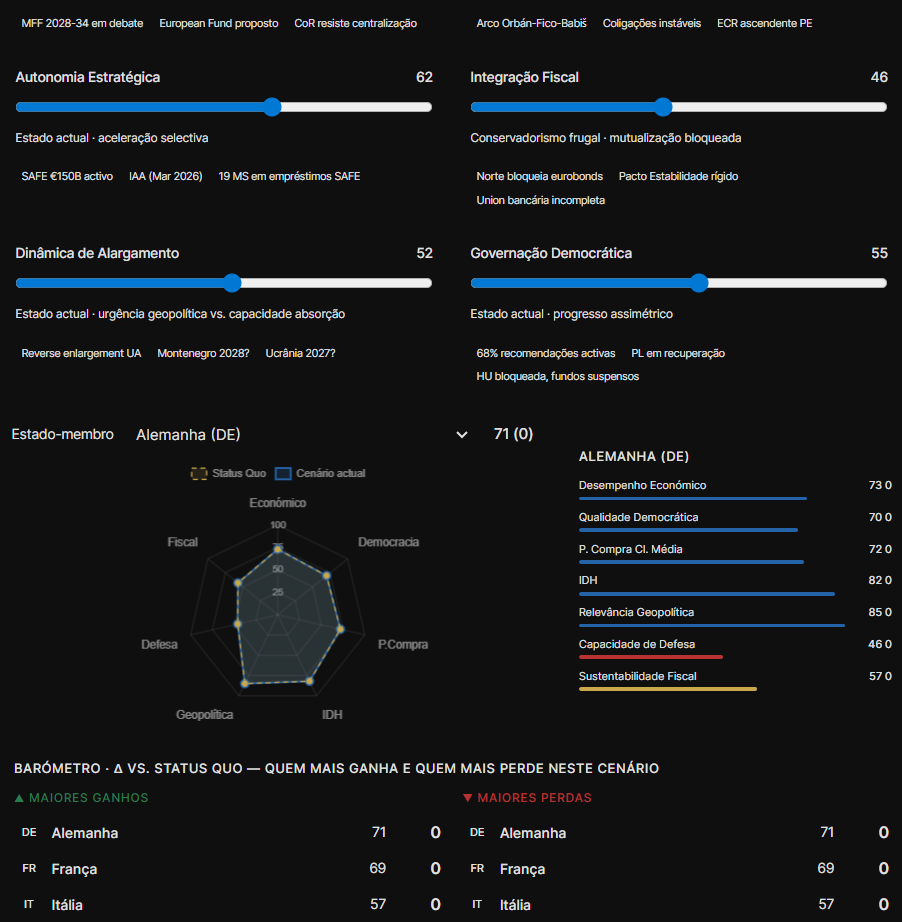
If this is in the interest of the EU+JACK nations — and there are strong reasons to argue that it is, both in terms of values and long-term economic interests — there is a powerful unifying and working basis for the immense diplomatic challenges that the bloc will have to face. The sharing of educated and increasingly cosmopolitan populations, common social values, sufficiently similar governance models, and pluralistic and democratic societies constitutes a substrate of coherence that neither of the two Suzerain Powers can replicate. As the reader of this article can check and test in the simulator we produced to complement this article, it is also a matter of survival for the main "European powers". Although counterintuitive, here's a teaser: it is surprising and revealing to see who the biggest losers and winners are in a scenario of EU fragmentation. Added to these factors are developed economies with great capacity for scientific and technological research — precisely the assets that the transition to the 21st-century economy values most. The sovereign path is not a utopia — it is a strategic interest. A cohesive EU+JACK bloc, with a decision-making architecture proportionate to its potential, is the only actor capable of offering the world an alternative to bipolar vassalage. The choice between this path and progressive accommodation to the feudal order is the most consequential political decision of this generation of democratic leaders.

Article III of this series descends to the level of the citizen—the ultimate recipient of all the choices their leaders make or postpone. It examines the structural inflation generated by geoeconomic fragmentation, its profoundly unequal distributional impact, and the implications for the democratic social contract in economies that are simultaneously paying the price of past dependency and financing—or refusing to finance—future sovereignty.
Article II of III | Economic Geopolitics Series
This edition of Chronicles of the Atopicosphere is part of a series of three articles on economic disruption, strategic sovereignty, and the impact on citizens.
Article I: Suzerain Powers And Economic Terror — From Asymmetric Disruption to Institutionalized Coercion
Article III: The Cost of Citizenship — Structural Inflation, Governance, and the Social Contract