New Feudal Domains, New Overlordship
Published on April 26, 2026

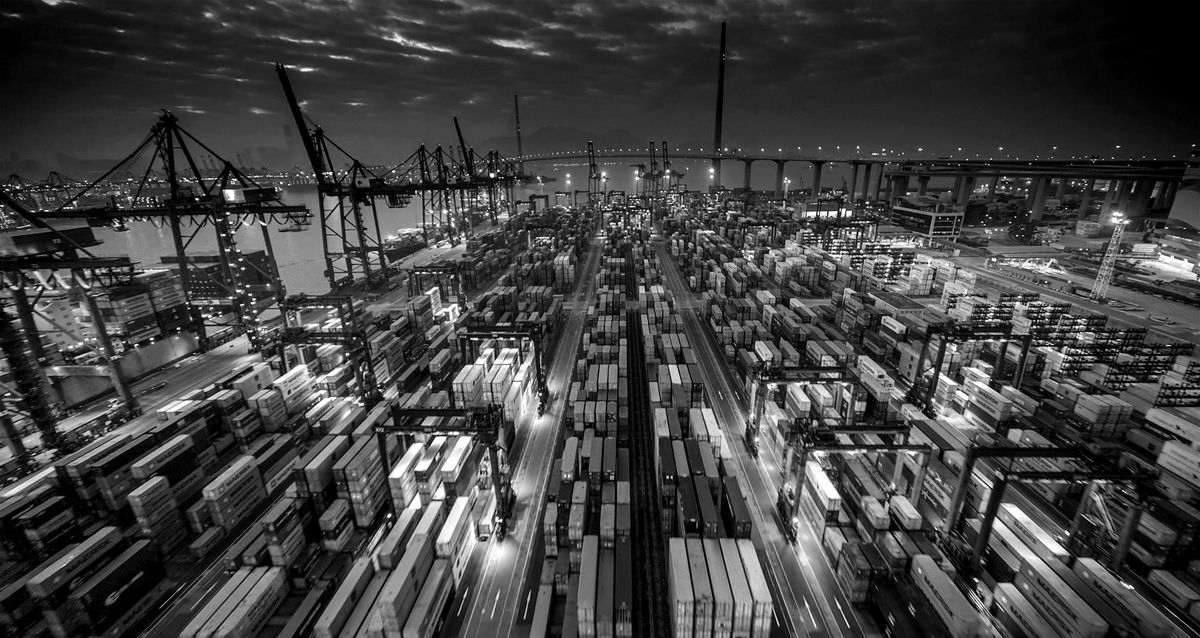
Supply chains, industrial power, and the reshaping of the global geopolitical order.
Analyses of the contemporary geopolitical order continue, to a large extent, to use 20th-century categories to describe a system that has transcended them. We talk about tariffs when we should be talking about value chains. We talk about borders when we should be talking about processing nodes. We talk about military powers when we should be talking about who controls the port, the semiconductor factory, the submarine cable, and the artificial intelligence laboratory. The territory of sovereignty in the 21st century is not land—it is the supply chain.
I. The Tariff Illusion: What "Liberation Day" revealed about our analytical blindness
On April 2, 2025, the Trump administration announced what it termed "Liberation Day"—a system of reciprocal tariffs on nearly all American imports, with rates reaching 145% on Chinese products and significant values on dozens of other countries. The reaction from economists was predictably one of alarm: gravitational trade models projected a contraction of American GDP between 1% and 2%, structural inflation, supply chain disruption, and coordinated retaliation. The reality that followed was more complicated—and analytically more revealing than the debate that preceded it.
Since the beginning of President Donald Trump's second term, analysts and academics have grappled with the fallacy of irrationality that generates an apparent paradox: how to explain a foreign policy that combines unilateral withdrawal from multilateral institutions with threats of territorial acquisition, pressure on historical allies, and simultaneous confrontation with systemic rivals? The conventional answer—attributing the events to chaos, the president's personality, or a diffuse "MAGA" ideology—proves insufficient to explain the underlying coherence of the actions.
Following "Liberation Day" the American economy showed a resilience that surprised many analysts. Growth continued; inflation was real but partially absorbed; unemployment did not skyrocket. The surprise itself is the diagnosis: it reveals that dominant economic models continue to analyze 21st-century international trade with 19th-century conceptual tools. Ricardian trade theory—the exchange of final goods between countries with distinct factor endowments—is a poor approximation of the system that actually exists: fragmented production networks distributed across dozens of jurisdictions, where what is exchanged are not products, but tasks, components, and services embedded in global value chains.
The concept that best captures this reality is the 'smile curve' proposed by Stan Shih, founder of Acer, in the 1990s: the distribution of value-added along a global production chain takes the form of a U. The ends—design, R&D, branding, software, intellectual property, after-sales services—capture the largest fraction of the value. The middle—manufacturing, assembly, logistics—captures much less. The American economy sits, with remarkable consistency, at both ends of this curve. An iPhone accounted for as a Chinese import of approximately $450 has an estimated American value-added of about 60% of the retail price—design, operating system, chip architecture, branding, distribution. The tariff is levied on the CIF (Cost, Insurance, and Freight) value at the border; the real impact on the American economy is on the fraction of the value actually created in China, which the most rigorous studies place between 15% and 25% of the total.
A tariff on 'Made in China' goods is not a tariff on China—it is a tariff on the stage of the value chain that happens in Chinese territory, in a process whose total value was created across multiple jurisdictions. Confusing "made in" with the content is the central analytical error of the tariff debate.
There are, however, three additional absorption mechanisms that conventional tariff models do not capture. The first is margin transfer: a significant fraction of the tariffs was absorbed by Chinese exporters in the form of margin compression—consistent with American market power as a global-scale buyer of last resort. NBER studies estimate that between 20% and 40% of the 2018-2019 Trump tariffs were absorbed by exporters, not passed on to American consumer prices. The second is rerouting: Vietnam, Mexico, Thailand, and India became transshipment hubs and relocation sites for assembly stages, shifting trade flows without altering the underlying structure of the value chain—the 'Made in Vietnam' of 2025 is often a product with Chinese components assembled elsewhere to avoid customs classification. The third is sectoral composition: tariffs primarily affected goods; the American economy is over 70% services, where import dependence is structurally low and competitive advantage is robust.
The most disturbing—and increasingly defensible—interpretation is that the Liberation Day tariffs were not designed to produce the effects that conventional economic analysis evaluates. They were instruments of bargaining leverage in a system where Washington identified that its position as buyer of last resort and issuer of the global reserve currency is the most underestimated geopolitical asset of the Bretton Woods system. The 'economic self-harm' is deliberate and calculated: the US knows it can absorb the cost of tariffs better than most trade partners, precisely because of the structural reasons of the smile curve and dominance in the services sector. The shock is asymmetric by design. This reading dissolves the boundary between trade policy and economic coercion—and that is exactly why the debate must be refocused on supply chains, not tariffs.
 amorsantos
The analysis of new forms of economic intervention for leverage and coercion in negotiation and geopolitics is developed in depth in Article I of this series
II. The China that stopped being the middle of the curve: The rise of R&D and industrial repositioning
The dominant narrative about China in Western analysis crystallized about a decade ago into an image that no longer corresponds to reality: a low-cost production giant occupying the middle of the smile curve—assembly, simple component manufacturing, logistics—and depending on the West for the R&D, design, and intellectual property that generate true value. This narrative was convenient. It was also false, and it has become dangerously false.
Chinese research and development data for 2025 redraw the profile of an actor that is rapidly climbing toward both ends of the curve. China’s R&D intensity reached 2.8% of GDP in 2025—surpassing for the first time the OECD average and the European Union average. The country became the first to hold more than 5 million valid domestic invention patents, with filings under the Patent Cooperation Treaty (PCT) leading the world for the sixth consecutive year. In artificial intelligence, China registered over 38,000 patents between 2014 and 2023—the highest volume in the world. In industrial robotics, it became the second-largest global exporter in 2024, with exports growing 61.5% in the first half of 2025. The added value of the digital economy grew 9.3% in 2025, and the information transmission, software, and IT sectors expanded by 11.1%.
This acceleration has structural characteristics that distinguish it from previous Asian technological catch-up cycles. The Japanese and Korean models followed a linear trajectory: absorption of foreign technology, learning by imitation, and gradual development of own capacity. China is operating in parallel across multiple vectors: massive state investment in basic R&D coexists with a private business ecosystem that in 2024 spent $201 billion on R&D—with 27.6% annual growth in valid patents—with the attraction of R&D from foreign multinationals that identify the Chinese ecosystem as the most dynamic in the world for proof of concept and rapid commercial scale, and with forced technology transfer—euphemistically termed 'joint venture requirements'—and industrial espionage that CISA analysts estimate has cost the West between $200 and $600 billion annually in intellectual property over the last decade.
China in 2025 is not just the world’s manufacturer—it is increasingly the world’s laboratory. The distinction between the actor who executes and the actor who conceives is collapsing faster than Western geopolitical analysis is prepared to recognize.
The most disturbing confirmation of this repositioning does not come from Chinese data—it comes from the behavior of Western companies. Bosch committed $1.4 billion in R&D investment in China for the next five years, focused on autonomous driving. Danfoss built a second R&D campus in Jiaxing. Bayer identified China as the market contributing the largest share—15%—to its global consumer health innovation portfolio. This is not about localization to access the market—it is about recognizing that China is today one of the most dynamic innovation ecosystems on the planet, with a unique ability to compress the cycle between proof of concept and commercial scale that more regulated economies take years to traverse.
The critical nuance this analysis requires is the distinction between R&D volume and quality. Rigorous academic studies identify that the expansion of Chinese patents was partially subsidized by government incentives that inflated volumes without guaranteeing proportional quality; that the industrialization rate of invention patents—the percentage that translates into marketable products—was 53.3% in 2024, below American and European standards; and that there are still relevant gaps in basic R&D, where the distinction between research without a defined application and research oriented toward immediate goals produces, in the long term, paradigm shifts that goal-oriented systems rarely generate. China faces equivalent challenges in high-end semiconductors, where ASML and American dominance in chip design create barriers that no volume of investment can quickly tear down. But the trajectory is unequivocal: the distance between China and the global technological frontier is compressing in multiple domains, and in some—solar energy, electric vehicles, batteries, drones, 5G, high-speed rail—it has already been reversed.
III. Mastery of Supply Chains: China as the architect of the new logistics geography
If industrial repositioning is the vector pushing China toward the ends of the smile curve, mastery of supply chains is the vector that allows it to control what happens in the middle—and transform that control into geopolitical leverage. The strategy is not new, but in 2025 it reached a scale and sophistication without historical precedent: no actor, in any period, has built a logistics control network with this geographical scope and vertical integration.The Belt and Road Initiative (BRI) is the most visible manifestation of this strategy, but reducing it to the BRI is to underestimate it. What China has built over three decades is a supply chain architecture across three simultaneous layers.
The first layer is the control of port assets: COSCO Shipping Ports today operates 375 berths in 39 ports worldwide, with 153 million TEUs of throughput in 2025—an annual growth of 6.2%, with overseas terminals growing at 11.5%. The portfolio includes controlling positions or significant stakes in Piraeus (the EU’s fifth-largest terminal and the largest in the eastern Mediterranean, with 284.7% throughput growth since the Chinese acquisition in 2016), Antwerp, Rotterdam, Valencia, Hamburg, Suez, and terminals in the US in Miami, Houston, Long Beach, Los Angeles, and Seattle. In November 2024, Xi Jinping remotely inaugurated the port of Chancay in Peru—a $3.6 billion investment designed to channel minerals and commodities directly to Asia, bypassing traditional Atlantic routes and creating a new South Pacific-China logistics axis that did not exist before. And in 2025, COSCO attempted to acquire a majority in a $23 billion consortium to buy 41 international ports from CK Hutchison—an operation that, if concluded, would have concentrated control over dominant fractions of throughput across multiple continents in the hands of the Chinese state.
The second layer is the control of routes and transport capacity: China controls, directly or indirectly, the container fleets that move most of the global trade. COSCO is the world’s third-largest container operator by capacity, and the concentration of the sector—where the four largest shipping alliances control more than 80% of global capacity—means that any pressure on COSCO has immediate systemic effects on freight costs and space availability for shippers who lack immediate alternatives. The chairman of COSCO Shipping Ports explicitly stated in 2026 that 'the expansion of our port network is a critical response' to intensified geopolitical competition—language confirming that port investment is state policy, not just commercial strategy.
The third layer, the least visible and most strategically relevant, is the control of digital supply chain infrastructure: China launched, in parallel with physical port investment, a digital infrastructure network—undersea cables funded by state-owned enterprises, supply chain management platforms based on Chinese technology, and the Digital Silk Road program that extends the BRI's architecture of dependency into the realm of data and communications. The port of Chancay was inaugurated with a set of 'Chancay series digital supply chain products'—creating from day one a dependence on Chinese platforms for the route's logistical management. China builds ports and then sells the systems that run them. The dependence is physical and digital simultaneously.
China is not just building infrastructure—it is building the architecture of dependency that will make that infrastructure irreversible. A port built with Chinese credit, managed with Chinese software, and served by Chinese fleets is not an asset of the host country—it is a node in the Chinese logistics network that the country merely has the illusion of owning.
The mechanism for weaponizing this architecture has already been demonstrated. The case of China ensuring tacit immunity for ships under Russian and Chinese flags during Houthi attacks in the Red Sea—while ships with links to Israel were systematically targeted—shows how control of maritime routes can be transformed into an instrument of trade discrimination without a single official declaration. The case of COSCO threatening retaliation if host countries block participation expansions demonstrates how port investment creates bargaining leverage over sovereign governments. Analyst Isaac Kardon of the Carnegie Endowment articulated it precisely: 'China can say: if you don’t let us be partners in your port, we can stop China's goods from reaching your port.' With 15% of global goods exports, that threat is credible.
 amorsantos
IV. The European Union: The world's largest market as an underutilized strategic asset
The European Union occupies a paradoxical position in the architecture of global supply chains: it is simultaneously the largest consumer market on the planet—with 450 million citizens having the highest average purchasing power in the world—one of the largest global industrial exporters, and the actor with the greatest de facto regulatory power over the norms that define access to international trade. And, simultaneously, it is the actor that most systematically underutilizes this power as an instrument of geopolitical policy.
The European Single Market is, from a supply chain perspective, an asset without a global equivalent. The ECB estimated in January 2026 that a reduction of just 2% in internal barriers to the trade of goods and services would fully offset the projected impact on European GDP of the 2025 American tariffs—a datum that reveals both the unrealized potential of the single market and the scale of the opportunity cost of the persistent internal fragmentation. Intra-EU trade has consistently proven more resilient than extra-EU trade during all recent shocks: during the pandemic, the energy crisis, and the 2025 trade war, intra-European trade contracted less and recovered faster, as companies replaced extra-European imports with intra-European supply when external shocks materialized—provided there was minimum internal production capacity. The single market is, in itself, a supply chain resilience mechanism—but only for those actors who manage to exploit it as such.
The second underutilized European asset is regulatory power as an instrument of market access conditionality. What geopolitical analysis calls the 'Brussels Effect'—the tendency for European norms to become de facto global standards because markets and producers prefer to adapt to a single rigorous norm for access to the world’s largest market rather than maintain diverging products—is one of the most documented phenomena of normative power in international economic relations. The General Data Protection Regulation (GDPR) became the global privacy standard. The battery traceability regulation will become the global standard for supply chain responsibility. The Carbon Border Adjustment Mechanism (CBAM) will become the global standard for carbon pricing. Each of these regulations is a market conditionality instrument that forces suppliers worldwide—including progressively China—to adapt their value chains to European requirements as a cost of access. It is power without weapons, exercised through bureaucracy and comitology. And it is surprisingly effective.
The third asset, increasingly relevant, is the EU's power as a gatekeeper of critical supply chains under disruption conditions. The evidence from 2025 is illustrative: when China applied pressure on the European automotive sector by suspending exports of microcontrollers and power semiconductors—an operation that lasted four weeks and caused significant disruption in just-in-time chains—the immediate effect was the acceleration of European supply diversification efforts. When Beijing imposed anti-dumping on brandy and investigations into dairy products in retaliation for tariffs on electric vehicles, Europe responded with trade defense instruments that revealed a coordinated response capability that Beijing did not expect to find. And when the European Court of Auditors identified in February 2026 that the trajectory of the Critical Raw Materials Act (CRMA) was insufficient to guarantee supply sovereignty, the political response was acceleration—not retreat.
The European Union has enough market power to impose supply chain conditionality on any actor wishing to access the 450 million consumers with the highest purchasing power on the planet. What it does not yet have is the political will to exercise that power with the consistency and speed that the geopolitical situation demands.
The European deficit is not one of capacity—it is one of decision-making architecture. Unanimity in foreign policy, the "veto discount" that produces minimal consensuses where maximal decisions are needed, and the internal fragmentation that persists even in the single market—where 60% of the barriers to services identified twenty years ago are still present—are political and institutional constraints, not resource limitations. Solving just 2% of internal market barriers offsets the American tariffs. Issuing common debt proved possible and effective. Regulatory capacity proved to be an instrument of global power. What is missing is not the instrument—it is the decision to use it with ambition proportional to the problem.

The dimension this analysis adds to the debate on European power is the perspective of supply chains as a vector of positive leverage—not just a vulnerability to be managed. The EU imports and exports dominant fractions of processed industrial goods to and from the rest of the world. Its intra-European value chains are the densest and most integrated on the planet. Intra-EU trade is the most robust buffer mechanism available against external disruption. And access to the European market is the de facto conditionality that structures investment and compliance decisions for suppliers on all continents. If Europe learns to instrumentalize these assets as a deliberate supply chain policy—and not just a market outcome—it has the capacity to become the third pole of a tripartite order, rather than the weakest link of a bipolar order.
V. The New “Land” of Suzerainty: Supply chains as a space of power
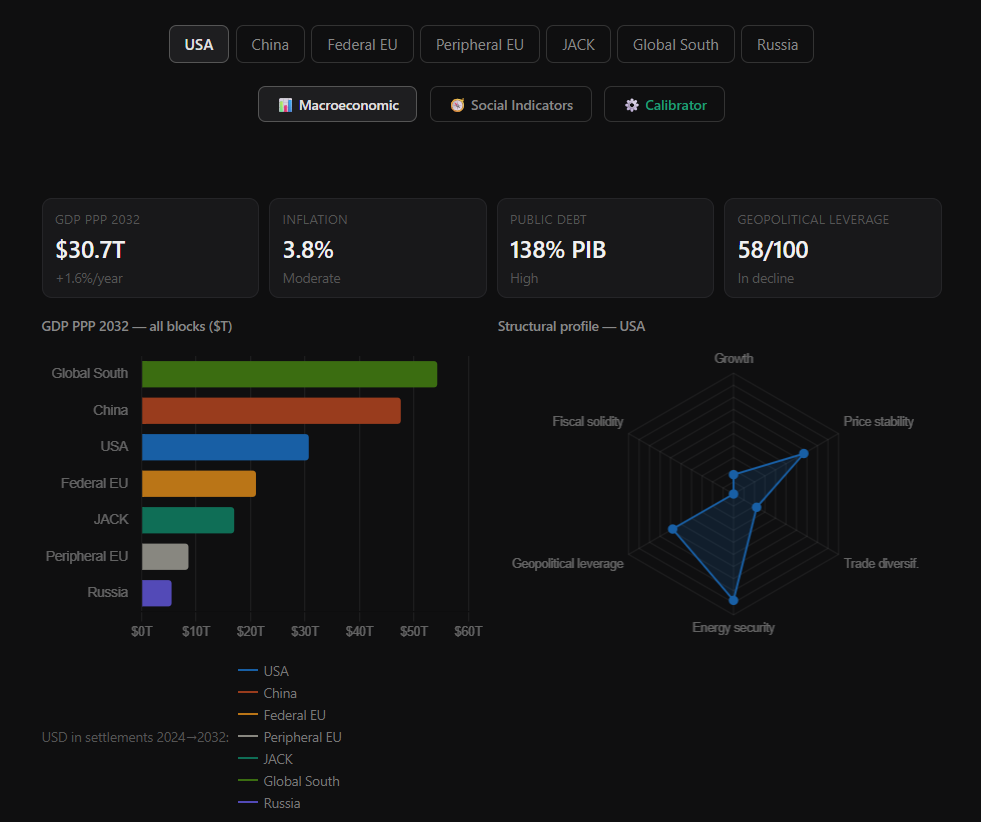
The analysis of the three actors—the US with its smile curve and privilege as buyer of last resort; China with its growing industrial power and architecture of logistical dependencies; and the EU with its market and regulatory power—converges on a conclusion that this series of articles develops systematically: the territory of sovereignty and power in the 21st century is not land—it is the supply chain.
The historical analogy that best captures this reconfiguration is that of the medieval European feudal system—not as a rhetorical provocation, but as an analytical structure. In classical feudalism, power did not derive from the military occupation of territory but from the control of resources that made that territory productive: land, water, trade routes, mills, bridges. The feudal lord did not need to be present in every village he controlled—he needed to control the nodes that made each village's production possible. He who controlled the mill controlled the grain. He who controlled the bridge controlled the trade. He who controlled the port controlled the world.
The power architecture that the US and China are building has a structurally analogous logic. The US controls the nodes of the global financial system—SWIFT, the dollar clearing system, rating agencies, capital markets where companies worldwide need to finance themselves—and uses this control to impose behavioral conditionality on sovereign states much as any feudal lord used control of the mill. China builds control over the nodes of the physical supply chain—ports, maritime routes, critical mineral refineries, digital cables, logistics management platforms—and uses this control to create dependencies that become, over time, as structural as the medieval farmer's dependence on the lord's mill.
What this metaphor illuminates—and what conventional geopolitical analysis often obscures—is that modern suzerainty requires neither military occupation nor a formal declaration of sovereignty. It requires that dependent actors have no practical alternatives to the nodes controlled by the suzerain. A port built with Chinese credit, managed with Chinese software, and served by Chinese routes creates a functional dependency equivalent to that of a farmer without access to the mill—but without any declared act of domination. A globalized financial system that denominates trade in dollars and can be disconnected by an American executive decision creates an equivalent dependency—but inscribed in contracts, not peace treaties.
Suzerainty in the 21st century is not proclaimed—it is accumulated, node by node, port by port, cable by cable, patent by patent. By the time dependent countries realize their condition, the alternatives have already been made expensive or time-consuming enough that change is practically impossible in the short term.
This is why the debate over tariffs—the debate that Liberation Day reactivated with all its spectacularity—is, in the end, a first-order analytical distraction. Tariffs are visible, measurable, reversible, and negotiable. Supply chain dependencies are invisible, structural, cumulative, and extraordinarily difficult to reverse. A country that depends on China for 90% of its processed rare earths cannot resolve that dependence with any tariff—it can only pay more for the same product or begin a ten-to-fifteen-year process of building alternatives, during which the dependence remains. A country whose financial system depends on the dollar as a settlement currency cannot resolve that dependence by decreeing new exchange rates—it can only begin an equally long process of creating settlement alternatives, during which the dependence remains functional.
The order emerging is, therefore, not simply a trade war—it is the consolidation of a new power architecture where control of critical supply chains becomes the functional equivalent of classical territorial control. The US attempts to preserve its position as financial and technological suzerain in an era where that position is structurally eroding. China builds an alternative position as logistical and industrial suzerain, with the historical patience of one who thinks in decades, not election cycles. And the space between the two—where middle powers try to preserve autonomy and smaller countries try to maximize their pivot position—is the space this series of articles examines: the space where the response of the EU+JACK bloc (Japan, Australia, Canada, South Korea) becomes strategically decisive, where the resources of Mercosur and the Global South become the prize of competition, and where the cost of every choice ultimately falls on concrete citizens who rarely perceive the power architecture that determines the prices they pay, the jobs they have, and the freedoms they exercise.

Article I of the series examines the normalization of supply chain disruption as a foreign policy instrument, from the Houthi attacks to the freezing of Russian reserves and the Australian rare earth embargo, drawing a parallel between the economic terrorism of pariah actors and the institutionalized coercion of major powers.
Editorial note on the series to follow
This preamble provides the conceptual framework for a series of three specialized articles.
Article I: Suzerain Powers And Economic Terror – Examines the normalization of supply chain disruption as a foreign policy instrument, from the Houthi attacks to the freezing of Russian reserves and the Australian rare earth embargo, drawing a parallel between the economic terrorism of pariah actors and the institutionalized coercion of major powers.
Article II: Sovereign Powers and Multipolarity – Develops the conceptual framework of asymmetric bipolarity and the global feudal order, examining how the EU, Japan, Australia, Canada, and South Korea can build an alternative path between the two Suzerain Powers.
Article III: The Cost of Citizenship – Descends to the level of human and distributive impact of this reconfiguration, analyzing how different governance models absorb or amplify geoeconomic shocks, and who actually pays the bill for strategic sovereignty.
The thesis running through the entire series can be stated briefly: we are living through the transition from a global economic order based on efficiency exchanges to an order based on strategic dependencies. In this transition, supply chains have ceased to be production instruments and have become instruments of power. And the response to this challenge—on the part of democracies that prefer autonomy to vassalage—will require deliberate, costly, and unpopular political choices that their leaders have not yet learned to honestly explain to the citizens who will pay for them.
Preamble | Economic Geopolitics Series
This edition of Chronicles of the Atopicosphere is part of a series of three articles on economic disruption, strategic sovereignty, and the impact on citizens.
Article I: Suzerain Powers And Economic Terror — From Asymmetric Disruption to Institutionalized Coercion
Article II: Sovereign Powers and Multipolarity — Strategic Sovereignty and the Choice Between Vassalage and Sovereign Multipolarity
Article III: The Cost of Citizenship — Structural Inflation, Governance, and the Social Contract